
By Roy Wells, Triad Strategies
One of the great constants in politics is change. Many organizations base their public affairs strategies on the belief that the current political environment will persist. The recent Pennsylvania election results underscore the risk of political complacency – becoming too comfortable with the current environment can leave organizations unprepared when it changes, turning a sense of security into a significant liability.
With Gov. Josh Shapiro re-elected, Democrats holding the House, and Republicans losing the Senate, Pennsylvania is entering its first period of unified Democratic government since 1993. The incoming Senate is projected to be 26 Democrats and 24 Republicans, while the exact size of the Democratic House majority remains uncertain. These changes have implications that extend well beyond state government leadership in Harrisburg.
For businesses, associations, and nonprofits, this election alters the assumptions underlying public policy strategy. Proposals that once faced significant obstacles may now receive serious consideration. Conversely, policies previously seen as secure may be re-examined, and existing relationships may no longer provide access to those shaping the policy agenda.
Going Back in Time
Pennsylvania’s history underscores the significance of this shift. A political trifecta occurs when one party controls the governor’s office and both legislative chambers. Since 1986, Pennsylvania has alternated between divided and unified government, with Republican trifectas lasting much longer than Democratic ones.
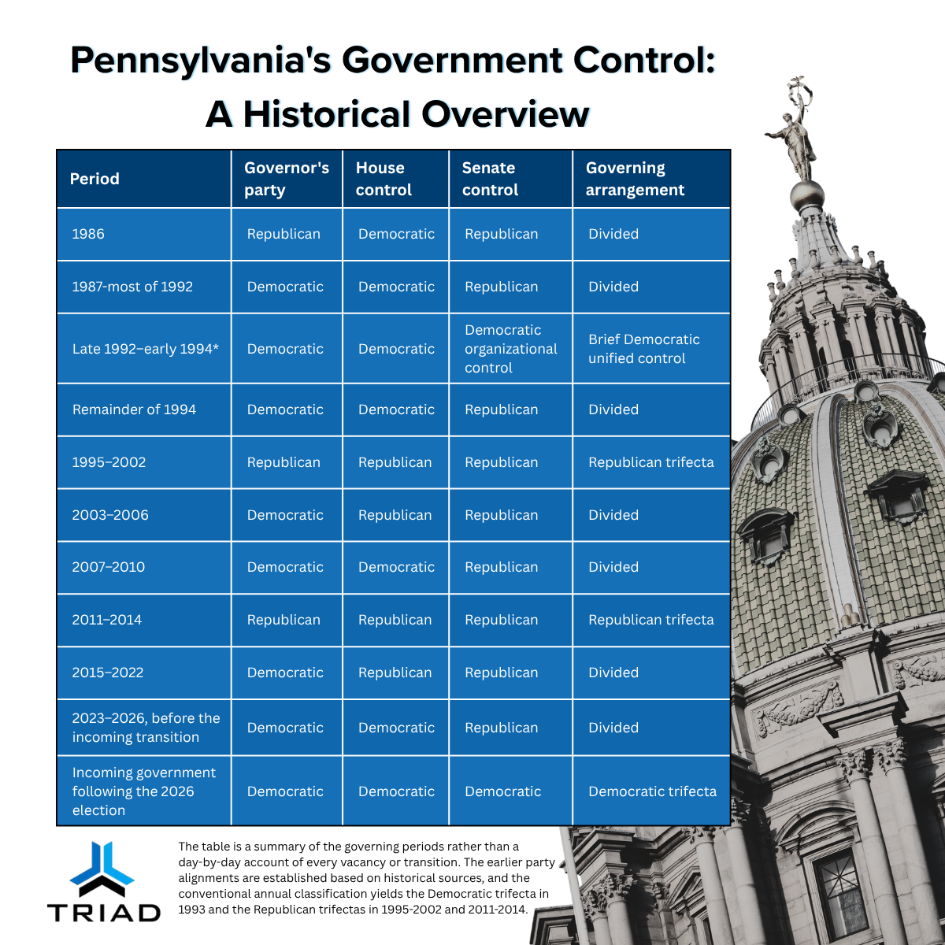
The Democratic period does require some historical precision. They took organizational control of the Senate in the final days of the 1992 session (with the backing of Sen. Frank Pecora) and held that control in the evenly divided chamber with a Democratic Lt. Governor. The Republicans took it back in 1994 after the court battle over the William Stinson/Bruce Marks special election. To describe 1993 as the last Democratic trifecta perfectly aligns with the standard annual summaries; the actual transition, however, spanned calendar years.
The broader trend is clear: divided government has been the norm in Pennsylvania for nearly four decades. Organizations adapted to an environment when passing legislation often required cross-party agreement, and opposition in one chamber could stop a bill in its tracks. This experience shaped expectations about what was possible, where risks lay, and which relationships mattered most.
Those expectations now require reassessment.
What a Political Trifecta Means for Policy
Unified government changes who can advance issues, schedule hearings, negotiate amendments, and guide legislation to passage. It increases the likelihood that long-stalled issues will receive attention and shifts decisive negotiations to focus more on differences within the governing party.
This does not mean every campaign promise will be fulfilled. A narrow Senate majority still demands significant coalition-building, and members representing their constituencies will have differing priorities within the same caucus. Minority party members continue to represent communities, contribute policy expertise, and help form coalitions. Organizations must understand these differences on an issue-by-issue basis, rather than relying solely on party affiliation to predict voting behavior.
Democratic leadership has outlined several priorities, including raising the minimum wage, funding mass transit, and protecting access to abortion. While these priorities set the agenda, the details of each proposal are still being determined. Organizations should engage actively, as policy decisions are still in progress.
Offensive vs. Defensive Approach
An offensive approach begins with re-evaluating opportunities that were previously set aside. Workforce initiatives, infrastructure investments, reimbursement changes, or proposals to improve government services may all merit reconsideration under new leadership. The goal is to align the organization’s objectives with public needs that policymakers are motivated to address.
This requires more than finding a supportive sponsor. You need a practical proposal, credible evidence, an understanding of fiscal implications, and partners who can articulate the importance of the change. It is also critical to identify which challenges must be resolved before the proposal can become law.
A defensive strategy also requires preparation. Organizations that previously relied on a single chamber to block unfavorable proposals must assess whether that safeguard remains. Waiting until a bill reaches a final vote leaves little room for pivoting.
Effective defense requires early engagement and clear definition of parameters, including implementation timelines, eligibility criteria, and compliance requirements. It involves explaining practical implications and proposing alternative solutions that address the underlying public concern. The more you assist policymakers in solving their core issues, the greater your influence on the outcome.
Due Diligence and Political Risk Analysis
Many organizations will need to address both sides of an issue. For example, an employer may commit to workforce investments while seeking changes to proposed employment requirements. Similarly, a healthcare organization may advocate for improved access while expressing concerns about funding mechanisms.
Political risk analysis helps leadership make informed decisions. It should assess the likelihood of policy changes, their operational and financial impacts, timing, and the organization’s ability to influence outcomes. It should also identify opportunities that may become more accessible as the political environment evolves.
Building Relationships
While an election establishes a new baseline, the environment continues to shift with changes in leadership, committee structures, budgets, and public opinion. Regular reassessment is necessary, along with clear responsibility for updating and acting on new information.
Relationships significantly enhance effectiveness. A change in power makes it essential to engage with incoming leadership, newly influential legislators, committee staff, and key constituencies. The goal is to establish mutual understanding early, enabling meaningful discussions before positions become entrenched.
When the political environment changes, organizations must first focus on relationship building, whether new or old, to enhance their credibility, strengthen their advocacy, and build a coalition of champions to cross the policy finish line.
What the Strategic Future Holds
At Triad, we believe political risk analysis should help organizations determine where to engage, what actions to take, what to protect, and how to prepare. Its value increases when integrated into ongoing relationships and grounded in a genuine understanding of the public interest. The goal is to enable organizations to participate effectively as circumstances evolve.
Pennsylvanians have reshaped the political landscape, and the state’s history shows that the current distribution of power will eventually shift again. The unknown is when.
Democracy does not run itself. Public affairs keeps it running.
