
By Roy Wells
Even if you’re familiar with the political landscape in state capitals across the country, a brief refresher on the institutional dynamics can help sharpen your hiring strategy.
Taking the time to research the political environment where you are seeking to hire a consultant is the first step in finding the right firm to advocate on behalf of your company.
State constitutions were written, rewritten, and amended throughout our nation’s almost 250 years of existence. Consequently, the states have different personalities which result in:
- Full-time (“professional”) versus part-time (“citizen”) legislatures;
- Annual versus biennial budgets;
- Strong governors versus weak governors; and
- States where one party has complete political control (a trifecta) versus those where control is split (also known as purple states).
Understanding these nuances will provide significant background as you begin identifying, interviewing, and ultimately hiring a consultant to join your team.
Full and Part-Time Legislatures
Generally, legislatures can be classified as either full-time (sometimes referred to as “professional legislatures”) or part-time (often referred to as “citizen legislatures”). These broad categories are typically defined by the length of the legislative session, the overall workload of the institution, member and staff compensation, and the availability of staff resources. In some academic literature, the more the legislature operates like the U.S. Congress, the more professional it is perceived to be.
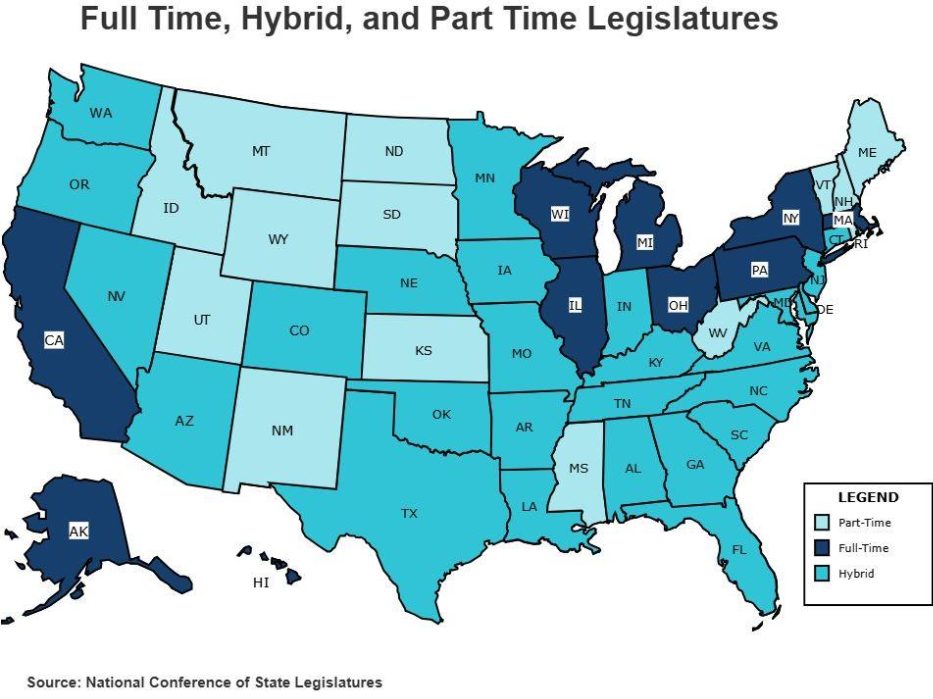
In a full-time legislature, you may need a firm that excels at year-round engagement. By contrast, in a part-time legislature, a firm with relationships that can navigate around short sessions may be more valuable. Given the varying lengths of hybrid legislative sessions, advocacy may focus on significant engagement before the session begins and during, when opportunities may be limited, and deadlines occur quickly.
The legislative structure is only part of the equation — how a state handles its budgeting can also influence when and how to engage, as well as who to hire.
Annual and Biennial Budgets
States with biennial budgets comprise a mixture of states that pass a budget once every two years without separate annual adjustments (i.e., North Dakota and Wyoming), or pass two one-year budgets, or annual budgets with biennial capital budgets. States such as Connecticut, Hawaii, Indiana, Kentucky, and Maine fall into these categories.
According to the National Association of State Budget Officers, 47 states are expected to enact a new budget this year for the fiscal year 2026. Of these states, 31 will approve a one-year budget for fiscal year 2026, while 16 states will enact a two-year budget for fiscal years 2026 and 2027. Three states – Kentucky, Virginia, and Wyoming, have previously passed biennial budgets for fiscal years 2025 and 2026 (Proposed & Enacted Budgets – NASBO).
In biennial states where key budget decisions occur once every two years, your advocacy plan may differ considerably from those in states with annual budgets that require consistent yearly engagement.
Strong and Weak Governors
You don’t need to understand all the historical determinants that have shaped the relative power of governors. What you do need to understand is that the power of governors can differ substantially from state to state.
Strong governors submit their direct budget proposals to the legislature, possess broad appointment powers over boards and commissions, exercise line-item veto authority, and often serve more than one four-year term. Examples of states with strong governors include Massachusetts, New Jersey, Florida, Illinois, Ohio, and North Carolina.
On the other hand, weak governors are characterized by limited or shared appointment powers due to a fragmented executive branch with many separately elected officials, feeble veto authority – with some even lacking a line-item veto, and in some cases, two-year terms of office.
In strong governor states, lobbyists with access to the executive branch are essential. In weak governor states, legislative relationships may be more influential.
Trifectas and Split States
The polarization we experience exists across the political spectrum and at all levels of government. As of July 2025, 23 states have Republican trifectas (one party controlling both legislative chambers – except for Nebraska, which is unicameral, and the Governor’s Office), and 15 states have Democratic trifectas. Within those states, the degree of partisan control may vary depending on the size of the majorities, and it is essential to consider the overall stability of the trifecta over time.
Twelve states can be categorized as purple since no single party controls all three branches of government. Not surprisingly, many of these purple states — Nevada, North Carolina, Virginia, Wisconsin, Michigan, Pennsylvania, and Arizona are also considered swing states in presidential elections.
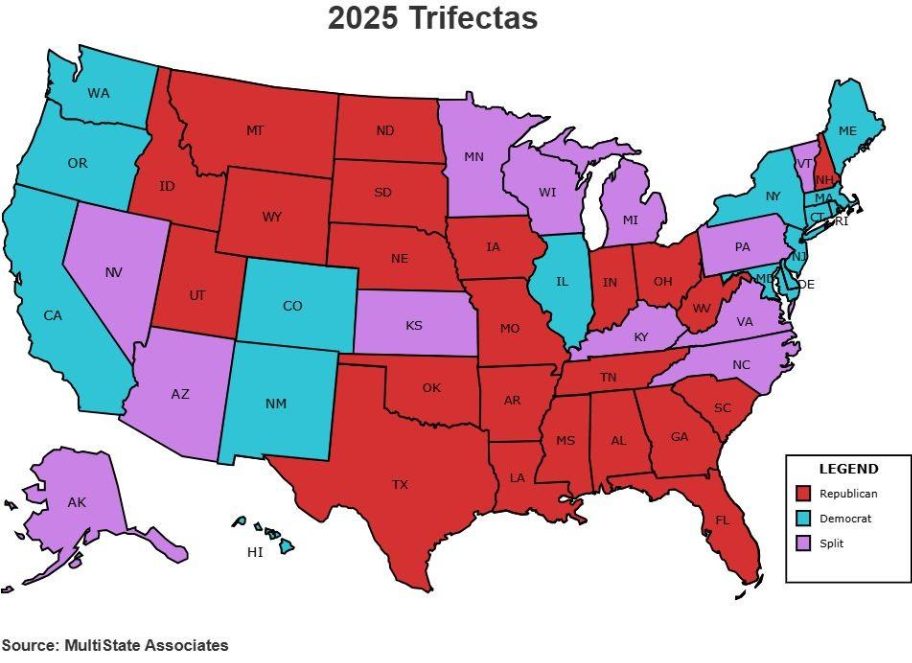
In trifecta states, policy agendas that align closely with the ruling party will likely require a like-minded firm. In purple states, a firm that utilizes bipartisan lobbying strategies may be the optimal choice.
Conclusion
Doing some basic research is critical. Just as you might conduct research on a vacation destination before making any specific decisions, the same logic should hold when hiring a public affairs consultant.
As a friendly reminder, when starting the process of hiring a consultant, it is essential to understand the state in which you need to do business, the complexity of your issue, your needs, and how you define success. From there, you can chart a course of action and speak with multiple consultants to ultimately find the one that best aligns with your definition of success and fits your organization’s purpose, mission, and culture.